


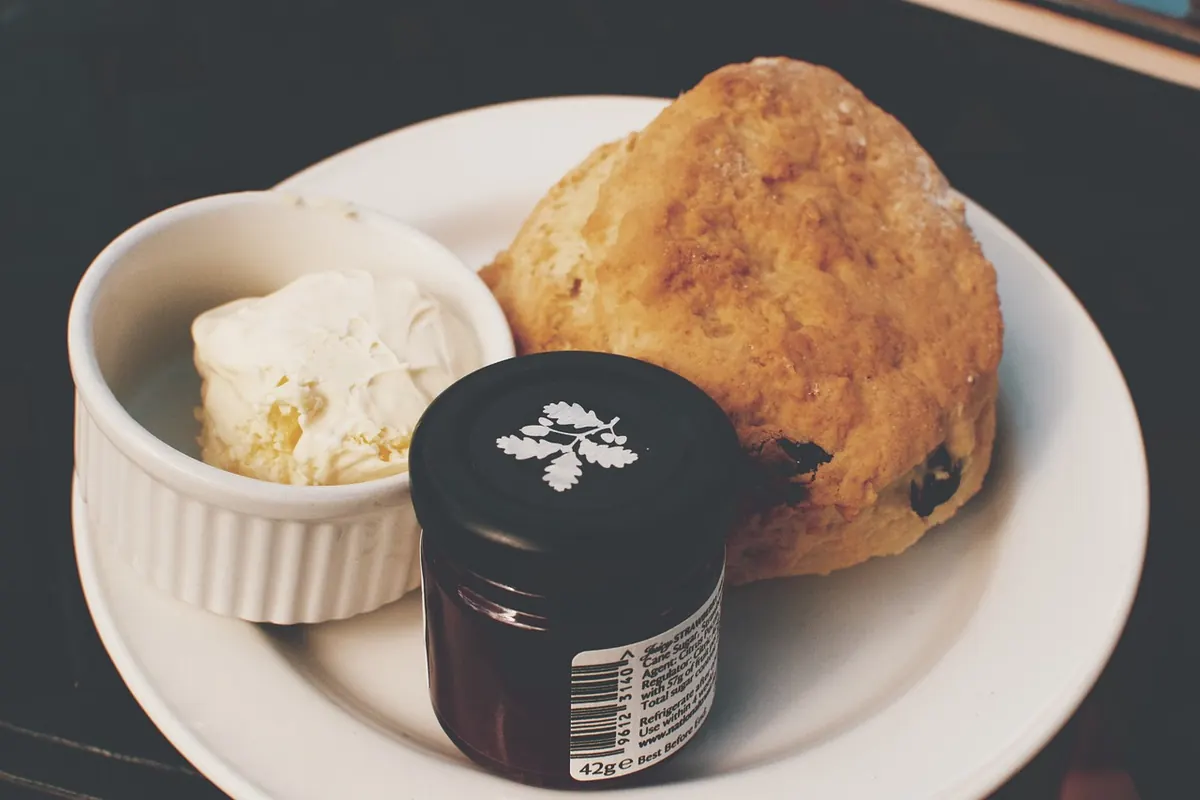
A cream tea in Cornwall arrives with very little ceremony and one unspoken rule. You get a scone — or two, if the day has gone well — a pot of strawberry jam and a bowl of clotted cream thick enough to stand a spoon in. What happens next is either local custom or a full-blown argument, depending on who is sitting opposite you.
For the record: in Cornwall the jam goes on first, then the cream. Most people here will defend that order with the calm certainty of someone who has never had reason to question it. It is worth knowing why the order matters, and what changes once you cross the Tamar.
What Actually Counts as a Cream Tea
A cream tea is not simply tea with cream in it, and it is not the same thing as afternoon tea. The shorthand version: scones, jam, clotted cream, and a pot of tea. Afternoon tea adds sandwiches, cakes and a certain amount of formality. High tea is a different meal altogether, a proper savoury supper with tea alongside.
The clotted cream is the part that cannot be faked. Cornish clotted cream is made from the milk of cows grazed in the county and has protected food name status, which tells you how seriously the region treats it. It is baked or scalded slowly, then left to cool so a thick golden crust forms on top. The texture should be dense and spoonable, not whipped and airy.
Where the Jam-and-Cream Argument Comes From
Nobody can put a firm date on the first Cornish cream tea, so treat any confident claim about its origins with a raised eyebrow. The usual story is that cream teas spread through the West Country in the late nineteenth and early twentieth centuries, as railways brought visitors down to the coast and tea rooms began serving what the local farms already had: cream, jam, and something baked to put them on.
That leaves plenty of room for two counties to develop two habits — and to spend the following century discussing it. Families will tell you their grandmother was doing it this way long before anyone wrote it down. They may well be right. There is no committee, no decree, and no consensus beyond the Tamar.
The Cornish Case for Jam First
The Cornish argument is not sentimental. It is practical, and it holds up in a kitchen.
Clotted cream behaves like butter. It is stiff, rich and slightly resistant. Spread it on a scone first and you have a slippery surface; try to add jam on top and the jam skates about, or you press harder and crush the crumb. Put jam on first and the cream can sit on top in a generous spoonful, holding its shape, so that every bite gets both.
There is also the matter of control. A thin layer of jam under the cream gives you a clean ratio: enough sharpness to cut the fat, not so much that the scone turns to pudding. Build it the other way and the jam tends to end up wherever it lands.
And the Look of It
A properly made Cornish cream tea has a certain appearance. The scone is split, the jam is spread thinly and evenly, and the cream is dolloped on top in a soft fold, still showing the mark of the spoon and the faint crust from the top of the bowl. It looks like two distinct things stacked, rather than one pink paste. That look is half the pleasure.
The Devon Case, Fairly Stated
Devon does it the other way round: cream first, then jam. The reasoning is just as sound on its own terms. Cream goes on like butter because that is what it is replacing, and a layer of cream stops the jam soaking into a warm scone. The jam sits on top in a bright spoonful, which looks rather good too.
Devon also tends to use a split rather than a round scone, and its cream is often a little lighter. If you are served a scone in Devon and the cream is underneath, nothing has gone wrong. You are simply in the wrong county for the argument.
How to Serve a Proper Cornish Cream Tea
- Start with plain scones. Fruit scones are perfectly acceptable, but plain ones let the cream and jam do the work. Make them small enough to eat in three or four bites.
- Warm them, do not heat them. Five minutes in a moderate oven is plenty. A scone straight from a hot oven will melt the cream into a puddle before it reaches the table.
- Bring everything to room temperature. Take the clotted cream out of the fridge half an hour before serving. Cold cream is unspreadable and tastes of very little.
- Split the scone horizontally with a knife or two forks. Do not press it flat and do not saw at it until it sheds crumbs everywhere.
- Jam first. A thin, even layer of good strawberry or raspberry jam. Use a spoon rather than a knife, and do not overdo it.
- Cream on top. A generous spoonful of clotted cream, left slightly domed. No spreading, no smoothing flat.
- Serve proper tea. A pot, brewed strong, with milk on the side. There is a separate and equally unwinnable argument about whether the milk goes in the cup before the tea; Cornish households disagree, politely.
- Eat it sitting down, with your fingers, ideally somewhere with a view of a field or a harbour.
If you cannot find clotted cream, a very thick double cream whipped only until it holds will do at a push. It will not be the same, and anyone from Cornwall will notice, but the scones will still be eaten.
Where the Custom Changes
Cornwall and Devon are the two poles, but the line between them is fuzzy. Tea rooms in north Cornwall, in Dorset and around Somerset often do whatever the owner was brought up with, and plenty of Cornish establishments will quietly serve it either way if you ask nicely.
Further afield, the Devon method tends to win by default. Hotels and tea rooms outside the West Country usually put cream on first simply because it sits close to the butter it replaces on a bread-and-butter plate, and because jam on top photographs well. In the United States and Australia, scones with jam and cream are common enough, but the order is rarely treated as a matter of identity.
What stays constant is the shopping list and the pace. Cream tea is not a performance. It is an excuse to stop at four o'clock.
Getting It Right at Home
Buy the cream a day or two ahead and keep it cold until half an hour before you need it. Assemble each scone only when someone is ready to eat it, because a dressed scone starts going soft within minutes and there is no rescuing it. Put the jam out in its pot with a clean spoon, keep a second bowl of cream for seconds, and resist the temptation to add anything else — no butter, no whipped cream, no lemon curd crowding the plate.
If you are feeding a mixed table, put both jars and the cream in the middle and let your guests commit to a side. You can be gracious about it. You do not have to agree with them.
Photo: StockSnap / Pixabay
Related posts
More stories you’ll love reading